Saab’s Q1 2026 Was Not Just Strong. It Was a Signal About Europe’s Defence Rebuild
Date published: 29 April 2026
Event date: 4th May 2026
Event location / region: Linköping, Sweden / European defence industrial base
Event: Saab Q1 2026 results release and investor webcast
Currency note: USD equivalents are approximate and rounded, using a working conversion rate of 1 SEK ≈ USD 0.1075, based on the SEK/USD rate available on 29 April 2026.
Saab’s first quarter of 2026 was not only a financial update. It was a useful indicator of how Europe’s defence industrial cycle is changing: from political commitments and order intake toward production capacity, delivery discipline and supply-chain resilience.
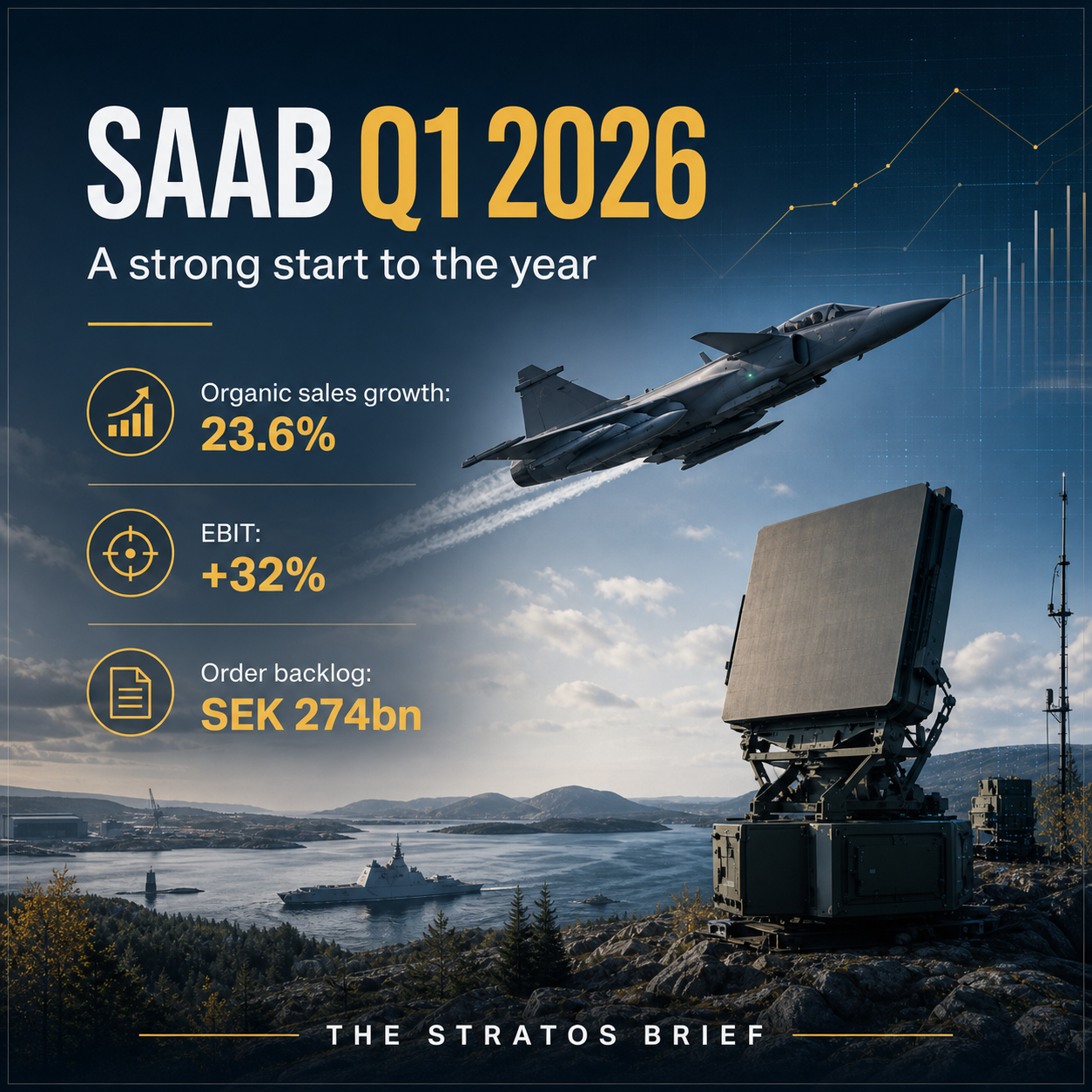
Saab entered 2026 with strong momentum. In the first quarter, the Swedish defence and security group reported sales of SEK 19.2 billion, or about USD 2.06 billion, up from SEK 15.8 billion, or about USD 1.70 billion, a year earlier. Organic sales growth reached 23.6%, operating income rose 32% to SEK 1.9 billion, or about USD 204 million, and the operating margin improved to 10.0%. Operational cash flow also turned clearly positive, reaching SEK 1.0 billion, or about USD 109 million, compared with a slightly negative figure in the same period last year.
At first glance, this looks like a standard strong quarter. But the more important message is strategic. Saab is showing what happens when defence demand becomes industrial reality. The company is not only receiving orders. It is increasing delivery volumes, expanding production, investing in capacity and trying to manage a constrained supply environment at the same time.
That is the real story behind Saab’s Q1 performance.
The demand signal remains strong, even with lower order bookings
Order bookings reached SEK 18.2 billion, or about USD 1.96 billion, slightly below the SEK 19.1 billion, or about USD 2.05 billion, recorded in Q1 2025. That decline should not be overinterpreted. Saab explained it mainly by fewer large orders in the quarter, while medium-sized orders increased strongly. The company also reported a book-to-bill ratio of 0.95x, with Surveillance and Dynamics both at 1.2x.
The backlog remains the more important indicator. Saab ended the quarter with an order backlog of SEK 274.1 billion, or about USD 29.47 billion, compared with SEK 189.2 billion, or about USD 20.34 billion, a year earlier. Around 72% of that backlog is linked to international markets. This matters because it shows that Saab’s growth is not only a Swedish defence budget story. It is a broader international demand story, driven by air defence, sensors, naval systems, combat aircraft, missiles, ground combat and electronic warfare.
For Europe, this is relevant because Saab sits in a strategically important middle ground. It is not a US prime contractor, and it is not a narrow single-product supplier. It is a European defence house with credible positions across air, land, naval, sensors, weapons and command-and-control systems. In the current security environment, that portfolio matters.
Surveillance is becoming a central growth engine
The strongest signal came from Surveillance. Sales in the business area grew by 32%, while operating income rose by 52%. Saab pointed to strong project execution, higher deliveries and increased deliveries of Giraffe 1X radar systems. The company also highlighted continued interest in GlobalEye and a SEK 2.6 billion, or about USD 280 million, Swedish order for a mobile and modular counter-unmanned aerial system.
This is strategically significant.
The modern battlefield is becoming more sensor-intensive, more drone-saturated and more dependent on layered detection and response systems. Armies, air forces and civil authorities are no longer buying surveillance systems only for traditional airspace monitoring. They are buying them to deal with drones, cruise missiles, loitering munitions, border threats, infrastructure protection and distributed air defence.
Saab’s Q1 numbers therefore point to a larger market reality: sensors are moving from supporting assets to central defence infrastructure. Radar, airborne early warning, electronic warfare, command systems and C-UAS capabilities are becoming core procurement priorities.
Dynamics shows the industrial logic of land warfare demand
Dynamics also performed strongly. Sales increased by 16%, EBIT rose by 38%, and the operating margin improved to 17.5%. Saab said the business area continued to see high demand, although order bookings declined compared with an unusually strong Q1 2025 that included a higher level of large orders.
This business area is especially relevant for Europe’s land forces. Dynamics includes ground combat weapons, missile systems, training and simulation, camouflage and signature management. These are not abstract future capabilities. They are directly connected to the lessons of Ukraine and to the urgent need to rebuild European stockpiles.
The margin improvement is also important. It suggests that higher deliveries and product mix can generate strong profitability once production volumes rise. But the same segment also shows the cost of expansion. Saab noted increased inventories and investments, which are necessary for growth but create pressure on cash flow.
For policymakers, this is a reminder that rearmament is not just about signing contracts. It requires financing production ramps, managing suppliers, carrying inventory and creating enough predictability for industry to invest.
Gripen remains strategically relevant, but the economics are more complex
Aeronautics delivered 15% sales growth, supported by the Gripen programme, while order bookings grew by 32%, partly driven by orders related to the T-7A programme. Saab also highlighted the rollout of the first Gripen E aircraft produced in Brazil as an important milestone.
At the same time, EBIT in Aeronautics declined. Saab linked this to higher R&D amortisation, negative currency effects and continued T-7A start-up costs. This is a useful reminder that fighter aircraft programmes are strategically valuable but financially complex. They require long-term development spending, export campaigns, industrial partnerships and sustained production discipline.
For Gripen, Brazil remains particularly important. Local production is not only a delivery milestone. It supports Saab’s argument that Gripen can be positioned as a sovereign, partnership-based alternative for countries that want modern fighter capability without full dependency on the largest US or European fighter ecosystems.
That does not remove the competitive challenge. The global fighter market remains dominated by political alignment, industrial offsets, interoperability requirements and long-term sustainment considerations. But Saab’s Q1 performance shows that Gripen E/F production is moving forward, not standing still.
Naval is moving into sharper strategic focus
Saab’s naval business also deserves attention. Kockums reported 54% growth in order bookings, primarily related to submarines, while sales increased 13%. Saab also noted that Kockums had entered contract negotiations related to Poland’s selection of Saab for its next generation of submarines.
From 1 April 2026, Saab established a new business area called Naval, consolidating Kockums with Naval Combat Systems, previously part of Surveillance. The purpose is to bring Saab’s naval capabilities together and strengthen its advanced naval offering.
This is not only an internal reorganisation. It reflects a wider European trend. Naval warfare is becoming more central in the Baltic Sea, the North Atlantic, the Arctic approaches and undersea infrastructure protection. Submarines, surface combatants, mine warfare, autonomous systems, naval sensors and combat management systems are moving higher on procurement agendas.
For Poland, the naval dimension is especially relevant. If Saab’s submarine negotiations progress, it would strengthen the company’s role in Central and Northern European defence modernisation, not only as a Swedish supplier but as a regional industrial actor.
Cash flow improved, but capacity expansion remains the key stress point
One of the more encouraging parts of the quarter was cash flow. Operational cash flow reached SEK 1.0 billion, or about USD 109 million, helped by higher profit, customer payments and improved working capital. However, free cash flow remained negative at SEK -301 million, or about USD -32 million, partly due to income tax payments and higher investment levels.
This is the central tension in Saab’s current phase. Demand is strong. Backlog is high. Sales are growing. Margins are improving. But the company must invest heavily to turn that demand into actual output.
Saab’s tangible fixed asset investments reached SEK 1.8 billion, or about USD 194 million, in the quarter, and inventories increased by SEK 1.9 billion, or about USD 206 million. The company explicitly noted that it is expanding capacity and production volumes, while also managing higher working capital needs.
This is exactly where European defence industry is now being tested. The bottleneck is no longer only political will. It is the ability to produce at scale, secure components, expand facilities, hire people, qualify suppliers and deliver on time.
The supply-chain warning should not be ignored
Saab also made clear that it is operating in a constrained supply environment. The company said it is taking proactive measures such as selectively stockpiling components and working closely with suppliers. In its risk section, Saab pointed to uncertainty in global supply chains, cost increases, trade barriers, tariffs, freight disruptions, rare earth elements, defence-specific supply and the ability of suppliers to ramp up production.
This matters beyond Saab.
Europe’s defence build-up depends on thousands of sub-suppliers, many of which are smaller companies with limited capacity and limited ability to absorb sudden demand spikes. The prime contractors may have order books. Governments may have budgets. But if components, electronics, energetics, castings, rare materials, software specialists or certified production capacity are missing, delivery schedules will still slip.
Saab’s performance is strong, but its own report shows that growth is not frictionless. The strategic question is not whether demand exists. It does. The question is how quickly the industrial base can convert that demand into credible military capability.
Ukraine, Poland and Brazil show Saab’s widening strategic geography
Several Q1 events also point to Saab’s expanding geopolitical footprint. Saab signed a memorandum of understanding with Ukrainian Defense Industry in aviation and airborne surveillance, and it also signed a collaboration agreement with Kyiv School of Economics focused on unmanned aerial systems and microelectronics. In Poland, Saab deepened collaboration with PGZ and WB Group. In Brazil, Saab, Embraer and the Brazilian Air Force presented the first Gripen fighter aircraft produced in the country.
These developments are not isolated public relations items. They show how defence companies are increasingly expected to act as industrial partners, technology partners and capacity builders.
Ukraine needs rapid capability development and industrial resilience. Poland is becoming one of Europe’s most important defence modernisation markets. Brazil remains central to Gripen’s international industrial model. In each case, Saab is positioning itself not only as an exporter, but as a long-term partner inside national defence ecosystems.
What Saab’s Q1 tells decision-makers
For investors, Saab’s Q1 confirms that defence demand is translating into growth, margin improvement and a historically large backlog.
For governments, it confirms something more important: the European defence industrial base can grow, but only if customers provide predictable demand, stable financing and realistic delivery schedules.
For armed forces, the quarter highlights where procurement priorities are moving: sensors, C-UAS, air surveillance, ground combat systems, missiles, naval systems and advanced platforms supported by software-defined and connected capabilities.
For competitors and partners, Saab’s performance shows the strength of a diversified defence portfolio. The company is not dependent on one programme or one domain. Its growth is coming from a combination of air systems, sensors, weapons, naval platforms and technical services.
That diversification is becoming a strategic advantage.
The bottom line
Saab’s Q1 2026 was strong, but the deeper message is not simply that Saab sold more and earned more.
The deeper message is that Europe’s defence rebuild is entering its industrial phase.
Orders and political announcements are no longer enough. The winners in this phase will be companies that can expand capacity, protect supply chains, execute programmes, manage cash flow and deliver relevant capabilities at speed.
Saab’s quarter suggests it is one of the companies best positioned for that environment. But it also shows the challenge facing the whole sector: demand is rising faster than the old industrial system was designed to handle.
That makes Saab’s Q1 not just a company result, but a useful indicator of where European defence is heading next.
Sources
Saab Q1 2026 results press release, 23 April 2026.
Saab Interim Report Q1 2026, “A strong start to the year.”
SEK/USD conversion reference, 29 April 2026.